Network
Network
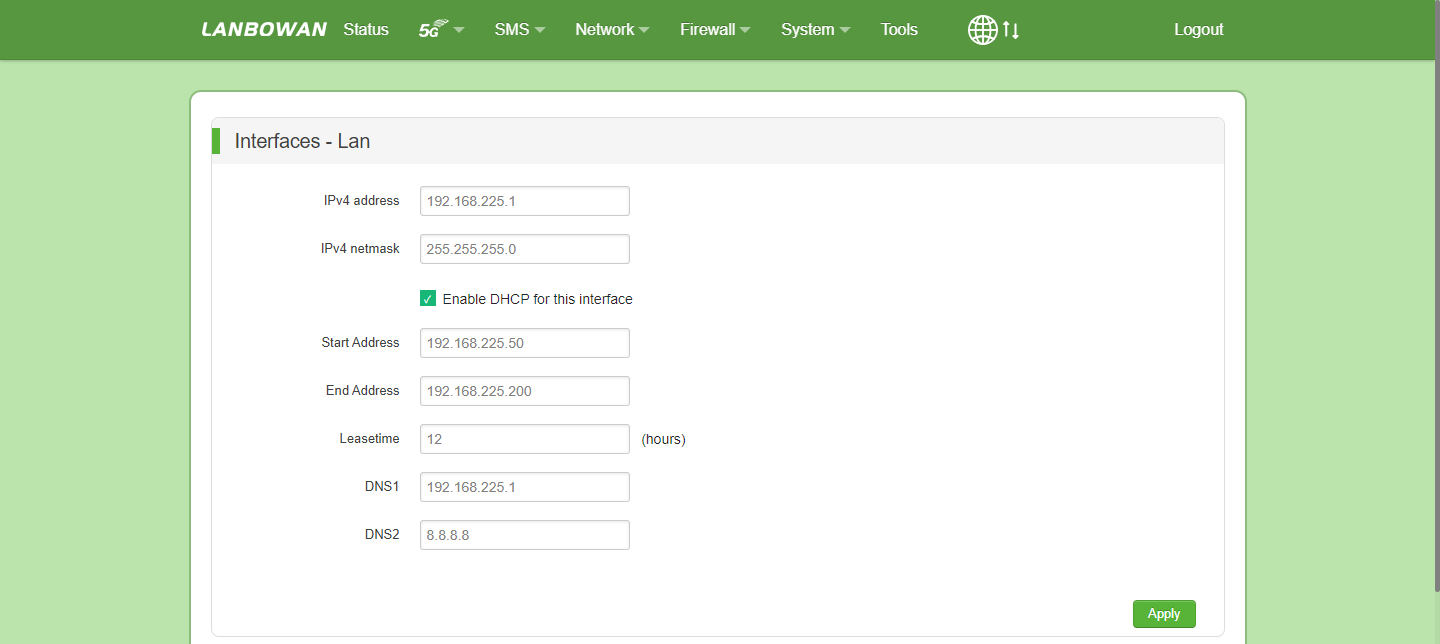
The Interfaces - Lan feature provides centralized control for planning the device's LAN-side network parameters, allowing administrators to configure the IPv4 address and subnet mask to define the internal network segment, and upon enabling the DHCP service, customize the IP address pool range, lease time, and DNS server (DNS1/DNS2) allocation policies, serving as the core configuration module for building the internal communication infrastructure and enabling automated terminal access.
Parameter Description:
| Parameter | Description |
|---|---|
| IPv4 address | Defines the IPv4 address of the LAN interface, which typically serves as the default gateway for all connected clients in the local network. |
| IPv4 netmask | Specifies the subnet mask for the LAN segment to determine the range of available host addresses within the local network. |
| Enable DHCP for this interface | Toggles the DHCP Server function for the LAN interface; when enabled, the device automatically assigns IP addresses and network parameters to connected terminals. |
| Start Address | Sets the starting IP address of the DHCP address pool, marking the beginning of the range available for dynamic assignment to LAN clients. |
| End Address | Sets the ending IP address of the DHCP address pool, marking the boundary of the range available for dynamic assignment to LAN clients. |
| Leasetime | Defines the duration (in hours) for which an assigned IP address is valid for a client; the client must renew the lease before expiration. |
| DNS1 | Specifies the primary Domain Name System (DNS) server address that will be distributed to LAN clients for domain name resolution. |
| DNS2 | Specifies the secondary or backup DNS server address used for domain name resolution when the primary DNS server is unreachable. |
The Active DHCP Leases feature is designed for real-time monitoring and centralized display of IP address usage allocated by the 5G CPE's DHCP service to online LAN clients, clearly presenting the client's hostname, assigned IPv4 address, unique MAC address, and remaining IP lease time in a list format; it serves as a core visual management module for network administrators to perform internal terminal asset inventory, IP conflict troubleshooting, and network connection status tracking.

Parameter Description:
| Parameter | Description |
|---|---|
| Hostname | Displays the device name or computer name reported by the client during the DHCP handshake process. |
| IPv4-Address | Shows the dynamic IPv4 address currently leased by the DHCP Server to the specific client device. |
| MAC-Address | Indicates the unique physical Media Access Control (MAC) address of the client's network interface card. |
| Leasetime remaining | Indicates the amount of time remaining before the current IP address lease expires and requires renewal. |
UPNP
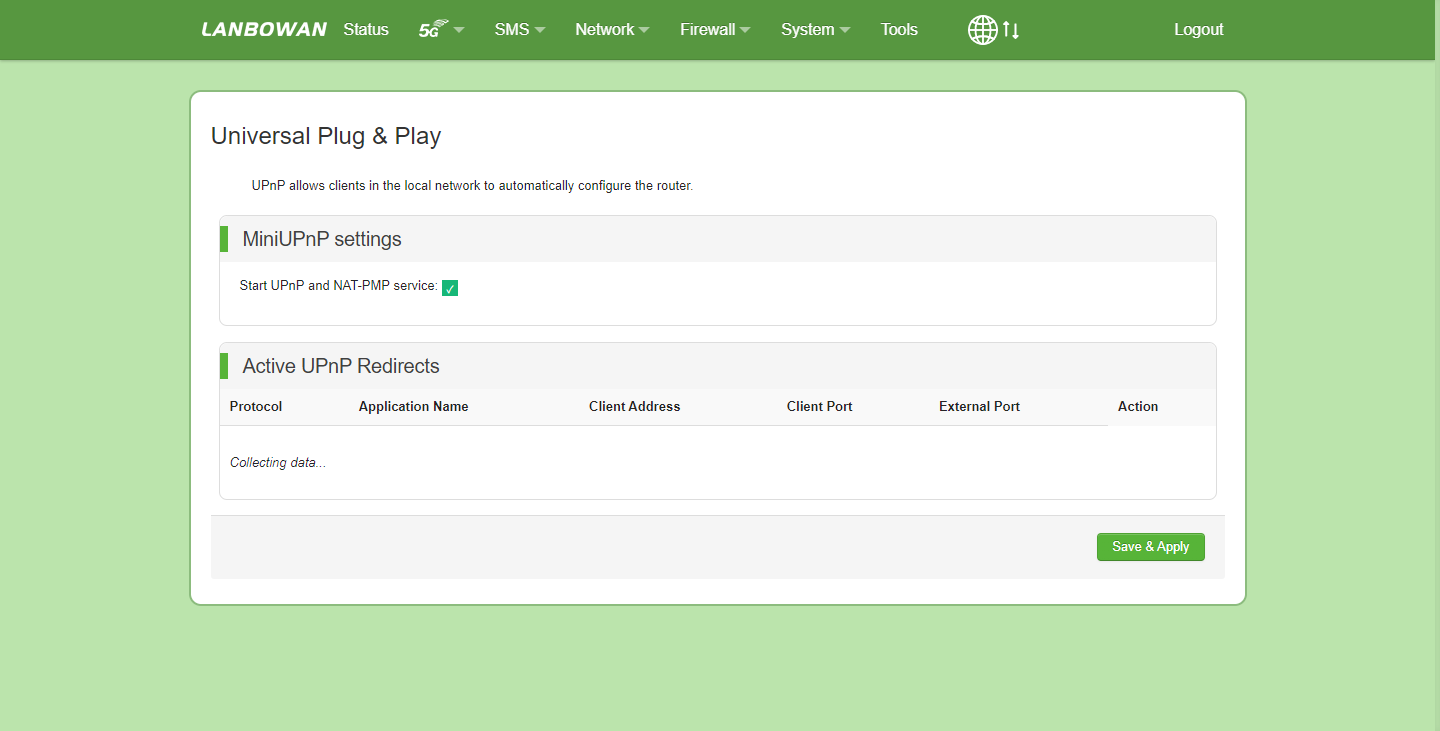
The Universal Plug & Play (UPnP) and NAT-PMP Service configuration module enables LAN clients (such as gaming consoles and P2P software) to automatically request and complete port forwarding and NAT traversal on the 5G CPE without requiring manual configuration by an administrator; this interface provides a global toggle for the MiniUPnP service and displays real-time active UPnP redirects—including protocol type, application name, client address and port, and the corresponding external port—serving as a core automation feature to ensure optimal public network accessibility and low-latency communication for internal applications.
SQM QOS
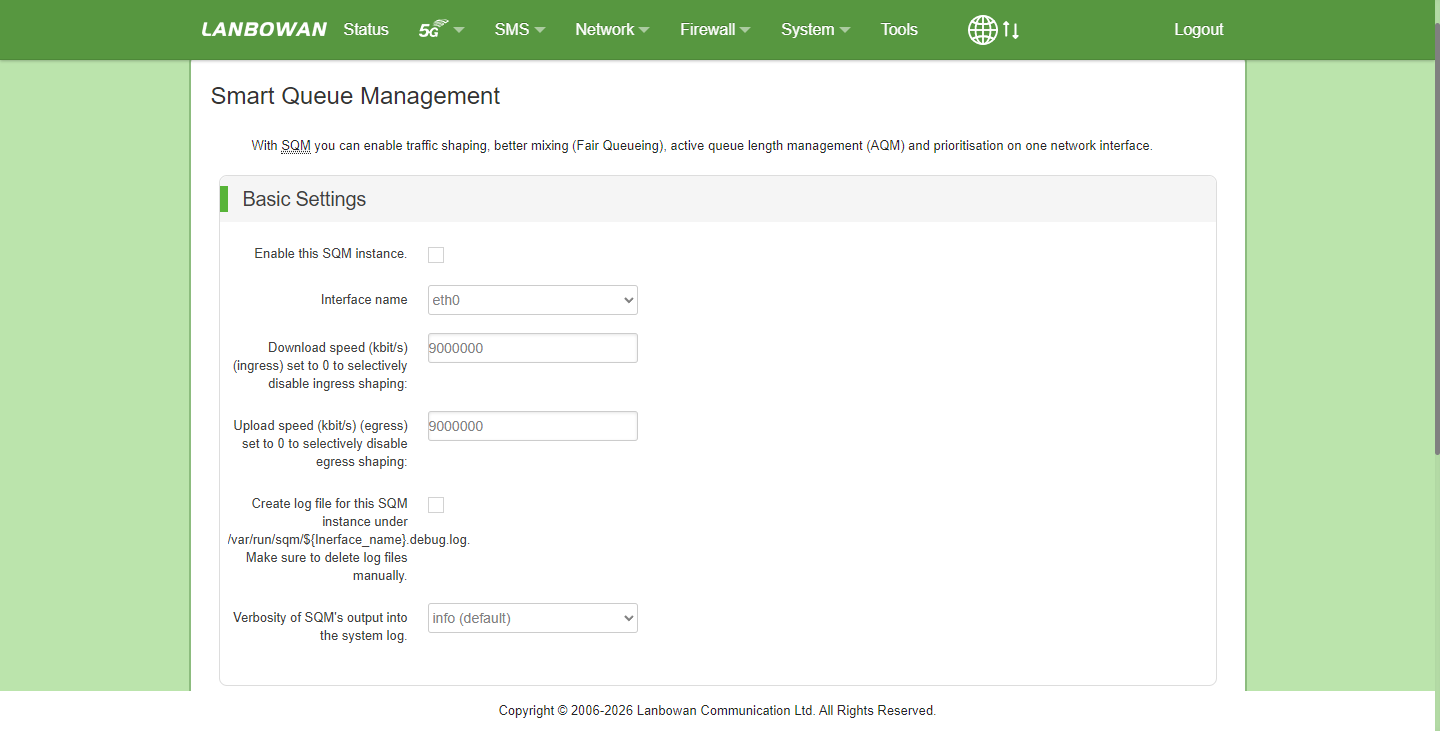
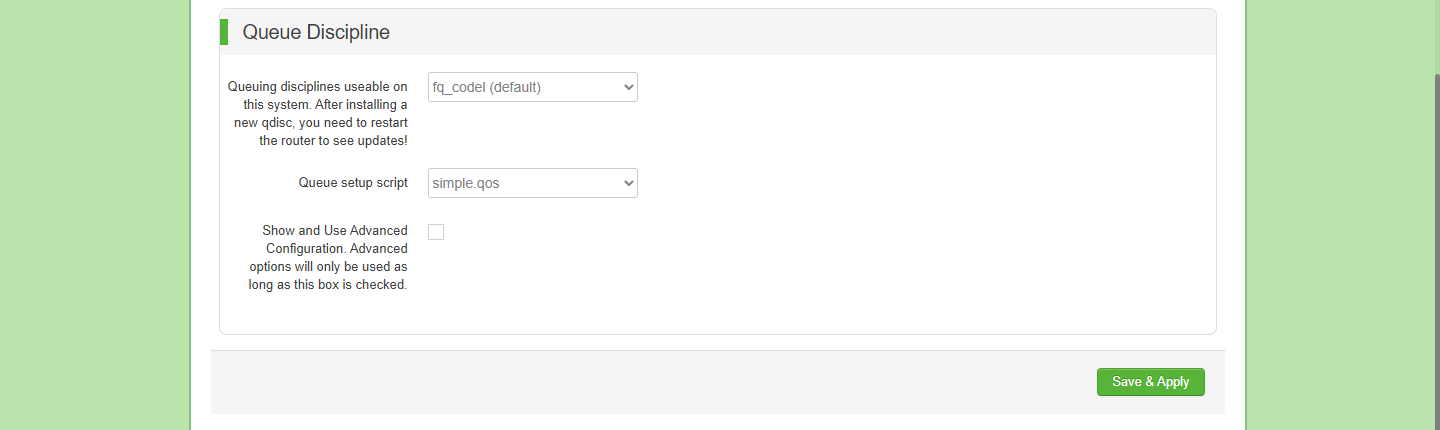
Smart Queue Management (SQM) is an advanced QoS feature based on traffic shaping and Active Queue Management (AQM), which effectively controls network bufferbloat to reduce end-to-end latency and ensures bandwidth fairness for high-priority applications by enabling traffic rate-limiting, Fair Queuing, and queue length management (e.g., fq_codel algorithm) on a specific network interface (such as WAN or LAN) of the 5G CPE; this configuration interface covers the global enabling of the SQM instance, interface binding, preset of upload/download bandwidth rates, designation of queue disciplines (qdisc) and scheduling scripts (e.g., simple.qos), as well as detailed system log verbosity settings, serving as a core network management function to optimize multi-service concurrency over complex 5G cellular network environments.
SNMP V2
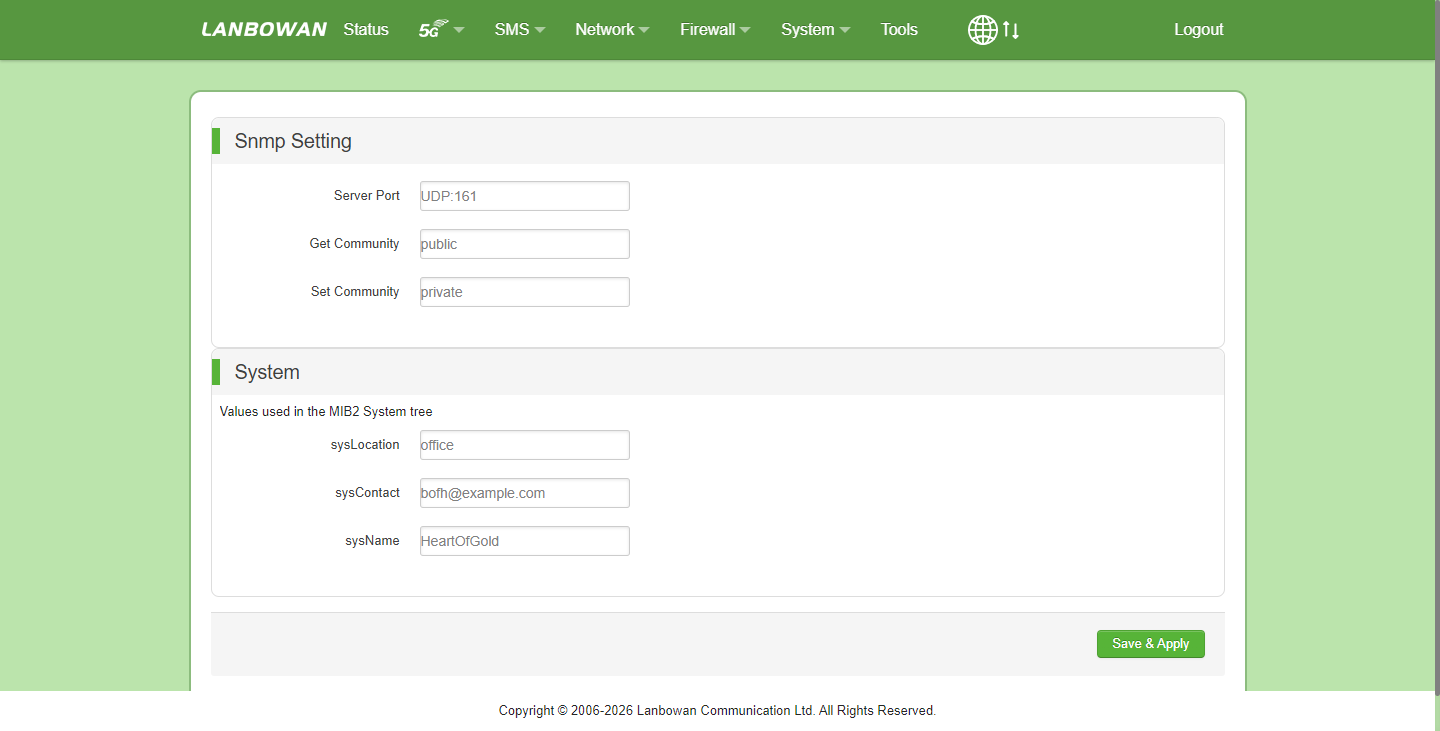
The Simple Network Management Protocol (SNMP) configuration module provides a standard network management interface for the 5G CPE, allowing administrators to remotely monitor device status, collect performance metrics, and execute configuration changes via a Network Management System (NMS); this interface covers the SNMP service port setting (default UDP 161), security authentication based on read-write Community Strings (Get/Set Community), and the definition of system objects in the MIB-II System group—such as physical location (sysLocation), administrator contact information (sysContact), and device name (sysName)—serving as a critical feature for automated operations and centralized asset management of 5G terminals in enterprise-grade networks.