
Firewall
DMZ
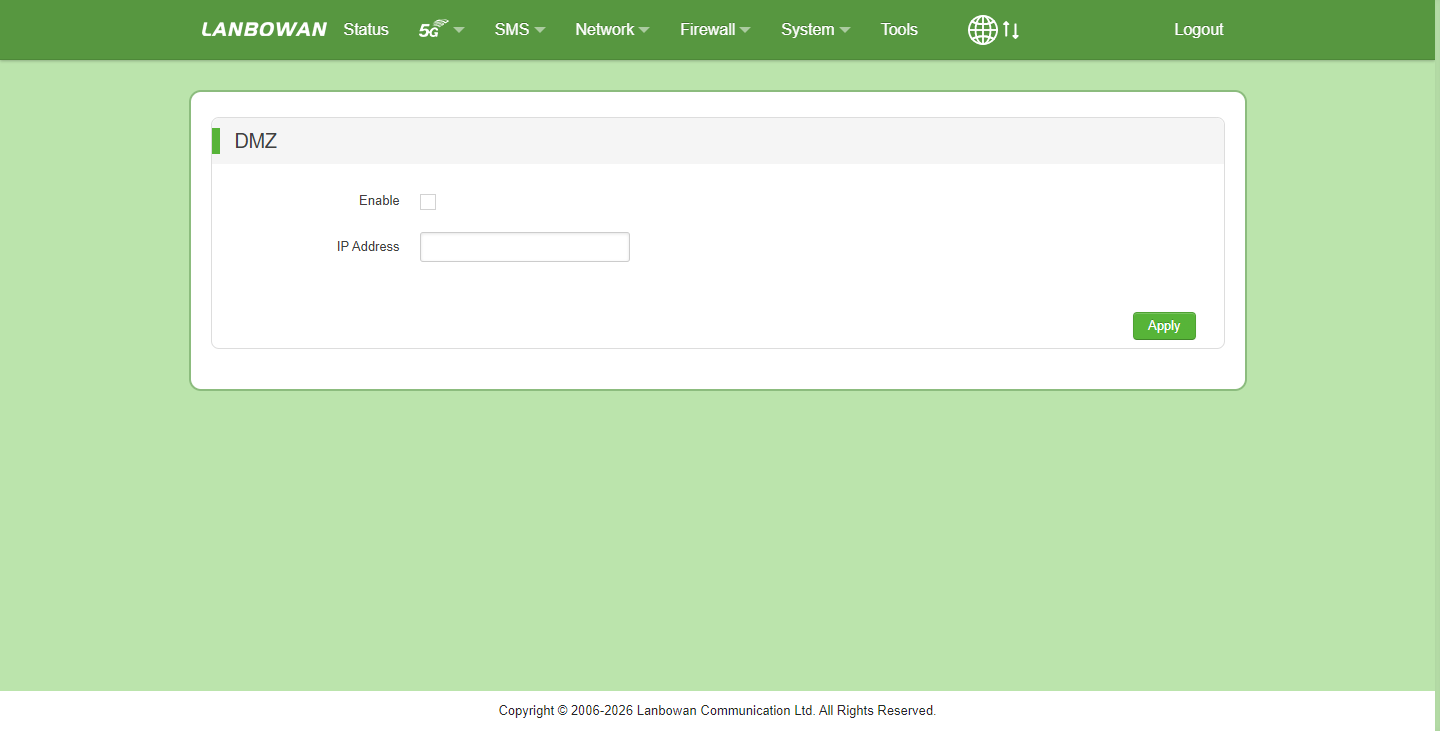
The Demilitarized Zone (DMZ) feature is an advanced network security and port mapping enhancement that allows the 5G CPE to fully expose a specified host's IP address in the LAN to the public WAN side, enabling the host to unrestrictedly receive all inbound connection requests and unforwarded port traffic from the external network, thereby meeting the stringent requirements of game servers, video surveillance systems, or specific P2P applications for full-port public access; this interface provides a one-click enable toggle and an input field for binding the target internal host IP address, serving as a core Network Address Translation (NAT) management module in enterprise-grade and SOHO gateways for quickly deploying publicly accessible services while requiring careful risk assessment.
Port Forwards
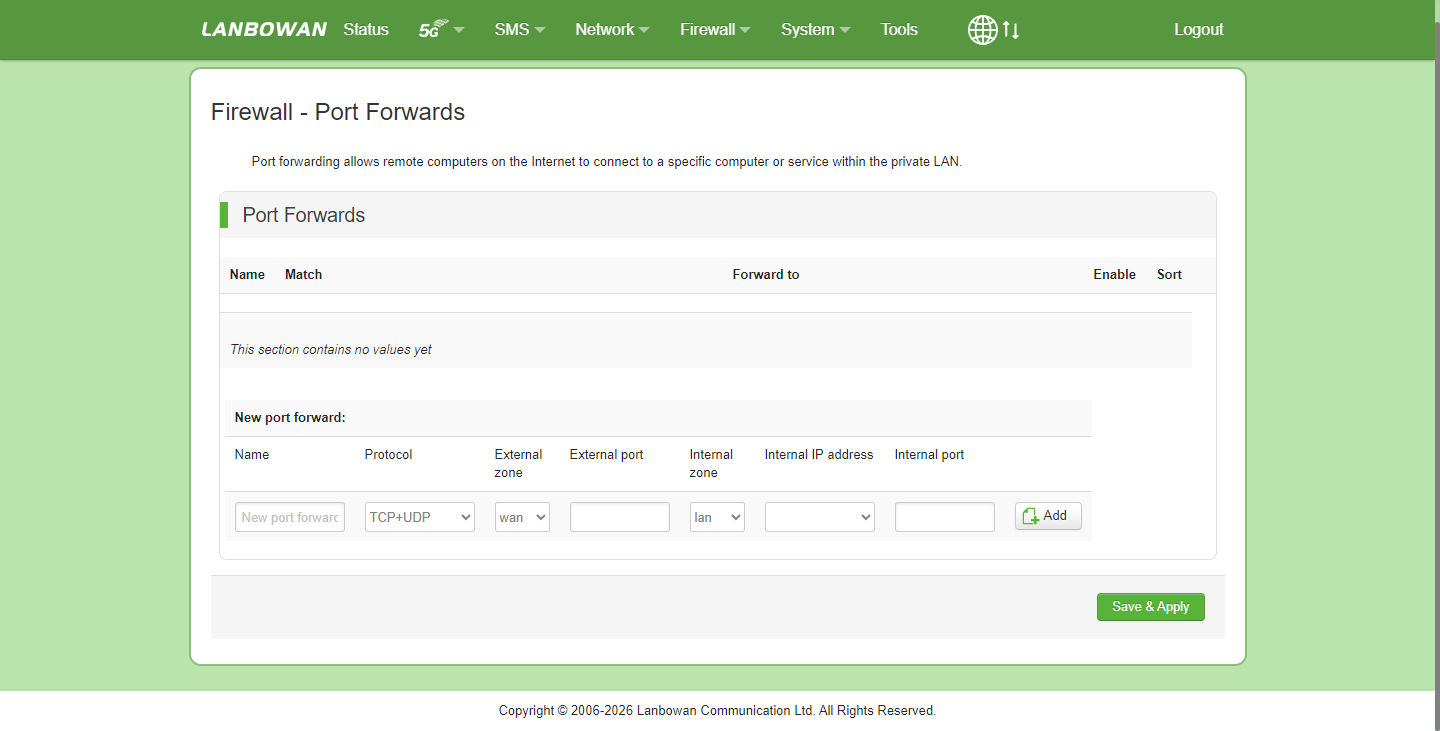
Port Forwards is a core Network Address Translation (NAT) feature within the 5G CPE firewall module that allows administrators to precisely map and forward specific protocol (TCP/UDP) and public port traffic from the WAN side (external zone) to a designated private IP address and service port on the LAN side (internal zone), thereby securely and controllably exposing specific internal services (such as web servers, remote desktops, or surveillance devices) to the internet; this interface provides granular configuration options including rule naming, internal/external zone matching, protocol and port range settings, and target internal IP/port binding, while supporting rule enabling, sorting, and real-time application, serving as a critical network management function for ensuring public accessibility and security isolation of enterprise-grade applications.
Tools
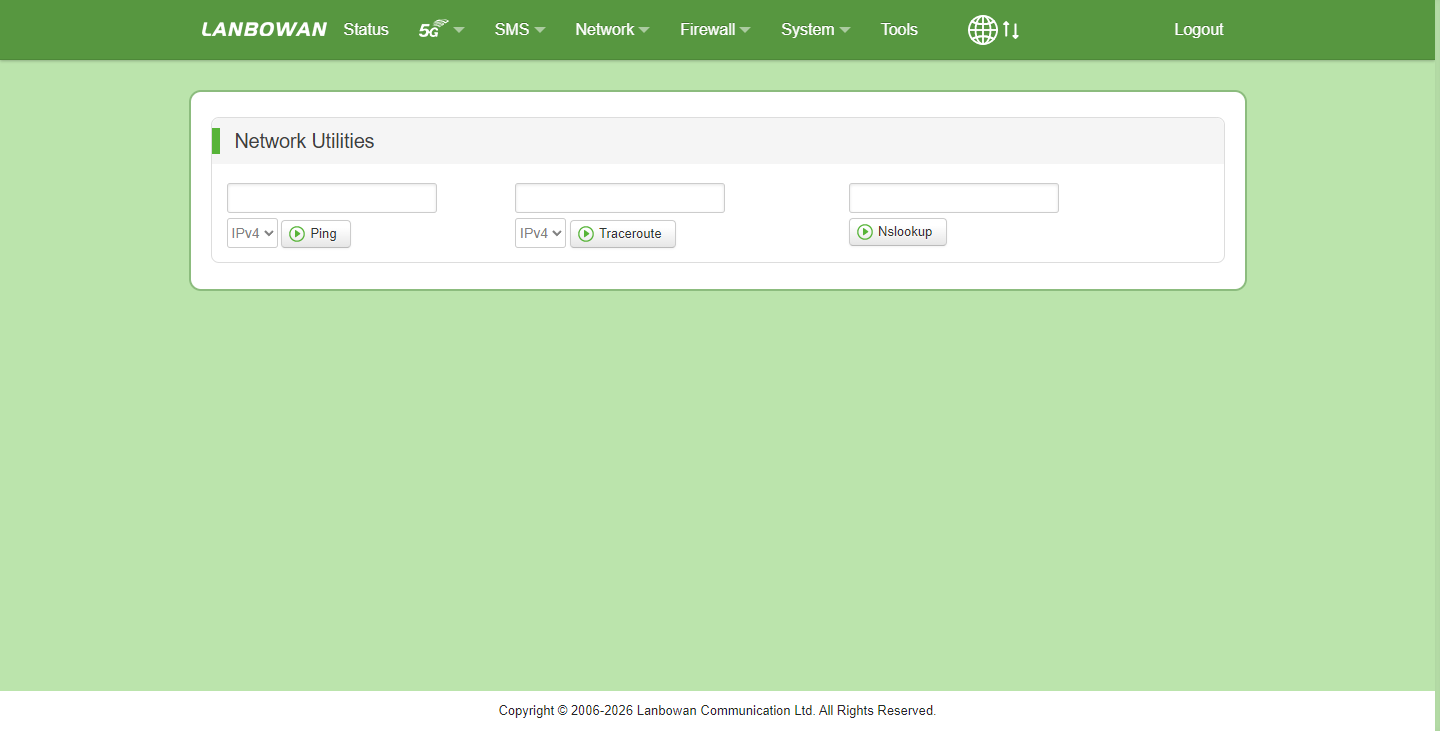
Network Utilities is a comprehensive network diagnostic and troubleshooting module built into the 5G CPE, integrating core network element management features such as Ping (connectivity and latency testing), Traceroute (route tracing and hop-by-hop analysis), and Nslookup (domain name resolution diagnostics) based on the IPv4 protocol; it allows administrators to directly input target IPs or domain names on the device's Web GUI to quickly detect end-to-end network reachability, locate link bottlenecks, and verify DNS service status, serving as a critical visual diagnostic tool for ensuring the stable operation and efficient maintenance of 5G cellular networks.
Parameter Description:
| Parameter | Description |
|---|---|
| Ping | A network utility that uses ICMP Echo Request/Reply packets to test the end-to-end reachability and measure the round-trip time (latency) between the 5G CPE and a target IP/domain. |
| Traceroute | A diagnostic tool that tracks the forwarding path of packets from the 5G CPE to a destination by utilizing TTL expiration mechanisms, identifying each hop (router) and measuring transit delays along the way. |
| Nslookup | A network administration command-line tool used to query the Domain Name System (DNS) to obtain the IP address corresponding to a domain name or to check the status and resolution records of the configured DNS server. |